
“There, now you do it.” Her clever fingers tucked the needle into the muslin as she handed me the hoop. Her smile said “Go on. You can do it,” and I knew right then that she was vesting me with great power.
I was so eager to show her I was paying such close attention, a grace I was not apt to dispense to the pair of temperamental cyclopes I had for parents. I had to show her how grateful I was for the untold hours she devoted to me, teaching me how to cross-stitch, indulging my nosy inquest into the chronicles of her life across two world wars, reading to me stories of the valiant Sir Ivanhoe and his perilous ventures to rescue the Lady Rowena, spending ‘just-because’ time with me, and now, entrusting her prim needlework to my unclever hands.
I held the delicate embroidery reverently, for a moment not quite certain what I should do with it even after she’d spent half the morning imparting all sorts of directions to me and I had pestered her relentlessly, “now can I do it, Nana?” “Nana, can I do it now, pleeease?”
With her power vested in me and unshakable trust in my heart, I attacked the fabric with a conviction.
“Nana,” I said after my first stitch. “Hmmm?” She was lost in thought.
“Like this?” I said proudly. “Very good,” she said. I beamed.
I loved Nana, and she loved me. She loved me in all the right ways. She was gentle. She was patient. She was kind. She disembarked in Callao docks one promising spring morning, bundled in a dark tweed coat and hatted with a neat little felt that kept her hair in place, braving the wind that blew atop the tall and stately Reina del Mar. Mum and I stood on the pier, her head cracked back, one hand cupping her eyes, looking to spot Nana across the widest row upon row of dwarf-sized voyagers pressed hard against the railing, waving wildly to the bunch of us waving wildly back.
We had been waiting there forever. The port authorities were taking their time to clear the ship for debarkation, and I was fidgeting, stomping out all the nasty puddles of inky water that had Mum surrounded, with my shiny new princess shoes Mum said were ‘for best only;’ a good enough time as ever if I was to save her from wicked watery beasts.
“Stay still, Annie. Look for Nana,” Mum said, my hand held tight in hers for I had a pesky habit, it seems, of running headlong to the very edge of terra firma to stand precariously in fascination of any haunting body of water. Apparently, Mum had been reduced to skin and bones by this very pesky habit of mine over the long sail back to Lima from Wales when I was two. “I was a pack of nerves,” Mum used to say during the course of a retrospection, “you’d run all over the deck, straight to the railing, me behind you, barely.” I could tell by the dark, disturbing whirl of her eyes that she was back on board, forging images of horrific impossible futures. She’d always finish her recount with, “I was so thin you couldn’t see me sideways.” I could swear she had lost a pound right that minute by sheer mental exertion. Poor Mum. Always a pack of nerves.
I craned my neck obediently to look for Nana, Mum assuming I would know who to look for. “There she is,” cried Mum and she pointed to a sweet old lady, all smiles catered to no one in particular, with one arm carrying a bulky bag and the other wrapped tightly around the handrail. She descended the steep ladder inch by inch, minding to secure her heels safely into each rung before she ventured a timid step downward. Every now and then she stopped and lifted her gaze to sweep over the crowd below. She hadn’t discovered us yet. I had a faint recollection I had known her before, and loved her before, and missed her before.
Nana knew how to mend. She mended splits and tears and sewed on buttons in clothes that Mum piled on the footstool right beside Nana´s favourite settee in the living room, “so you’ve got something to occupy yourself with,” Mum said, “I’ll be at Erika’s for a while.” And then Mum gallivanted off to visit her friend just around the corner. Nana didn’t like that very much. “Your Mum’s gallivanted off to Auntie Erika’s again,” she said, and her eyes made a full circle before settling on a sock to be darned. With my face in her work, I grilled Nana about wearing a thimble, threading a needle, about buttons and buttonholes, seams and hems, and this fabric and that. Before long, I was stitching together a piece of fabric Nana had reclaimed from one of Dad’s old flannel shirts and I produced a checkered sort of skirt that I wore proudly for days till I had shown it off to everybody and her aunt. Then I went on to new pursuits.
One day I was standing in the dim hall upstairs, head bent over my navel, intent on sewing back on the button I had just popped off my pants. Stick the needle under the fabric, through the buttonhole… pull the thread through… stick the needle into the other buttonhole… pull the needle underneath… stick the needle in again… I got it! I’m sewing on a button! I got it!
Someone was coming up the stairs. Nana, for sure. The stairs knew how to creak in a Nana way, just like they knew how to creak in a Mum way and in a Daddy way.
Show Nana! She’ll be so proud!
Nana reached the landing and stopped to catch her breath. She saw me and her light snuffed out like a spent candle’s.
“Oh, Annie, no! Never mend your clothes while you’re wearing them, for mending clothes upon your back, troubles and sorrows you’ll never lack.”
She recited these words of the times, and they stuck with me all the more strongly in that I had never disappointed Nana before.
“Annieeee, lunch is ready in five minutes!!” Mum announced from the kitchen. I was in the garden, scolding Michi for I caught him dipping his
paw in the pond trying to catch poor old Thomas who lived there all by himself, minding his own business. “Shame on you, Michi!” And I wanted to say so much more to him, so he learned a lesson, good and proper, but I had five minutes. Maybe I could pretend I hadn’t heard Mum. She had just gotten back from her visit at Auntie Erika’s but she didn’t see me, for as soon as I heard the rattling of keys at the front door of the garden, I hid behind the bamboo trees so the Enemy wouldn´t take me prisoner and force me to take off those dirty clothes, wash your hands, and brush your hair.
The Enemy was just as sly as I was, peeking into the garden to make sure the coast was clear. She closed the door quietly behind her, looked at her watch, and hurried her step tiptoeing across the garden path and through the door of the house. She was soon to take control of the cookhouse where infamous brews were prepared under her command and forced upon defenceless prisoners at the torture chamber.
No, that wouldn’t do. Mum would know I was telling a fib if I said I hadn’t heard her call; the house had a way of echoing sounds, like an empty room. I could even hear Mum interrogating the maid on her orders for today’s lunch: “Maria, está los cebollas picado bueno?” Mum had a funny way of speaking Spanish.
Mum’s ‘five minutes’ meant the same as Dad’s ‘make it snappy,’ so I knew I had to wrap up what I was doing and make myself presentable at the table, quick. Dad would be there, and Mum would be there, and Nana.
I would have to pass inspection by one or two or all three of them; the third was always the mildest review, the best given, and the best received.
There was no inspection this time; the oddest thing.
“You were at Erika’s, I take it,” said Dad.
“Yes, only for a while though, dear,” said Mum with a pretty pink in her cheeks. Then she went on to say, “That Erika. She’s a lucky one that one. I swear, if she fell in Callao docks, she’d come up with a handful of fish.” And she went on to report the latest of Auntie Erika’s tricks, as Dad called Auntie’s ways.
When Mum went to visit Auntie Erika she took with her the BBC voice she liked so much more than ‘that Welsh sing-song’ that Nana had; but, when she came back from Auntie’s she wore more of a Daddy’s voice, a drawl it was called. Daddy wore this voice all the time. Except when he got all smarted up for some job interview.
We sat at the table, Mum all smiles, Nana rather quiet, and Dad looking hot. No one was talking so I felt it was the right time to let them know I had scolded Michi.
“Shut your trap! Little children should be seen and not heard,” said Dad.
The Dragon is awake. It’s gonna start blowing fire. Get away from the Dragon. Now!
I ran from the table.
“Come back here, young lady!! Finish your food!! And what do you say when you get up from the table??”
I sat down again, a mighty prisoner. Say nothing. Make no eye contact with the Dragon or the Enemy. Put up a brave front in the torture chamber. Divert them so Nana can escape.
I sat there for ages. Dad had instructed Maria not to let me leave the table until I’d finished my food and said, “May I please be excused from the table.” Of course, Maria wouldn’t know what I was saying if I said it in English. I could use this to my advantage.
I spread out the cold food on my plate as flat as I could and said, “María?”
“Dime,” she replied from the ironing room.
“I’m going to play in the garden?” I said quite politely.
“¿Ya terminaste?” She asked if I’d finished my food.
I said “Sí,” and I added, “dejé una nadita,” I left next to nothing. And I was telling the absolute truth.
And Maria let me go. She would tell Dad, if he remembered to ask, that I had been very polite indeed.
Nana was sitting in the living room knitting and I was playing hide and seek with Michi under the coffee table. The doorbell rang and Maria scooted across the garden to answer. I heard her saying, “Pero los señores
no están, Oficial. No puedo hacerles pasar.” She was saying the master and mistress were not home, so she couldn’t let the officer in. Leaving the door open, Maria came running into the living room as if chased by a terrible monster. She was tripping over her words, something about a policeman and two men and a judge order. Nana couldn’t understand a word she was saying, and I knew the words but not what it all meant.
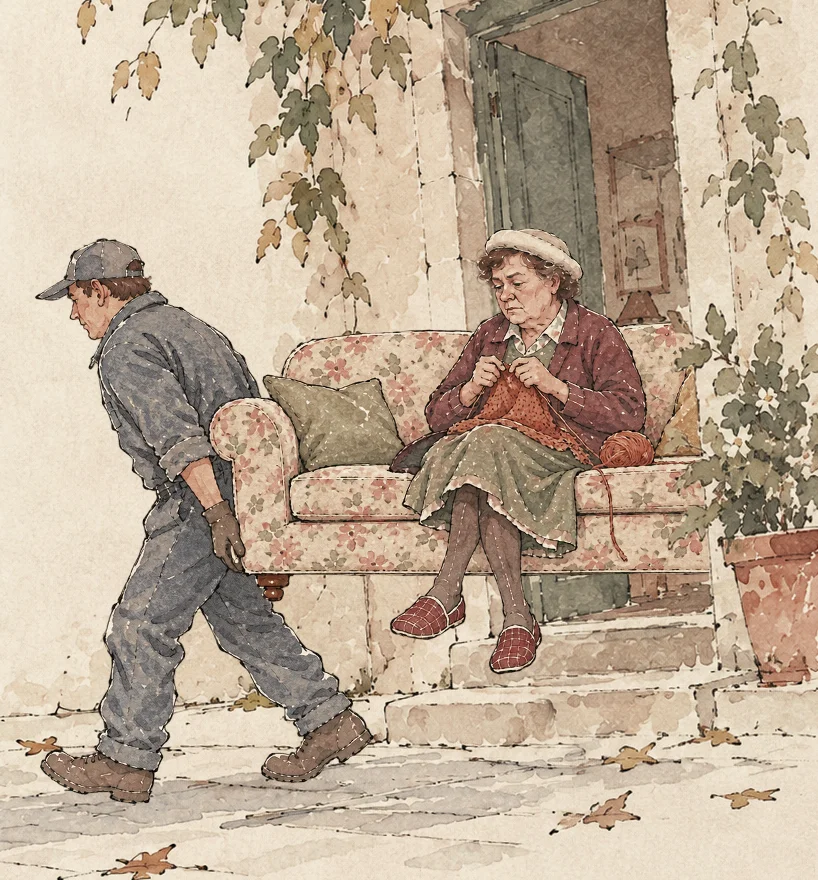
Then three men walked into the living room and the one in uniform said to Nana that they were there to execute a court order. The other two men walked to the TV set Dad had bought only a while ago and picked it up and carried it out the door, through the garden and into a truck waiting outside.
Nana begged them to wait until her daughter and son-in-law got back, but they kept on carrying our things away—the radio, the good armchair, the family picture frame, the flower vase, the clock piece Mum called Big Ben—and Nana kept begging them, “please, don’t take that…” “that’s a gift…” “my daughter bought that in England.” Then she was crying, “if you must take the frame, give me the picture” and her hands shook as she retrieved the photo from the frame.
Whatever she said or did, they couldn’t hear her, they couldn’t see her, for she had conjured that secret power she had. She could make herself invisible.
Under the coffee table, I dared not move. I kept quiet and still like a mouse, so they wouldn’t take me away, too. Then the man in uniform told
Maria that they needed to confiscate one last thing: the settee Nana was sitting on, her favourite spot.
Nana refused to let the settee go, so she sat more solidly on it, a force to be reckoned with. The two men picked it up with Nana on top and were carrying her away. Of course they were carrying her away. They couldn’t see her. She was invisible to them, so they were unaware they were taking her away, too.
I stood up from my hiding place like Mighty Mouse and bellowed a mighty cry for them to release my Nana.
Instantly, Nana hopped off the settee and ran away from the villains to my side. We hugged while we watched them load her settee, lock the truck doors, and drive away.
Nana’s secret power had been in some strange manner connected to that settee, for as it disappeared, never more to be seen, Nana never fully recovered from her state of invisibility. The only one who could always see her was me.
A good time after these and other more dismal events, when I no longer played ‘make believe’ games, I was at the airport seeing Nana off. I remember crying when the plane took Nana away, something I did not do
when Dad flew back to the States a few weeks earlier. Somehow, I knew I would see him again someday.
“Annie, you’ll see Nana again,” said Mum. Something in my heart told me I wouldn’t. I would never see Nana again.
To this day, I remember Nana’s warning words to me: Mending clothes upon your back, troubles and sorrows you’ll never lack. My hands have remained unclever. My kids taught themselves to sew on their buttons and will teach their own kids soon. My husband, such a dear, darns his own socks. All wears and tears and splits and rips I just throw out into the basura, because the garbage is where they belong. Gone forever.